Beyond water. Any engineered system. One decision layer.
Atlas is decision intelligence for operators and engineers—wherever equipment runs on a schedule, storage shifts loads, and constraints compete. Water networks. Power systems. Manufacturing plants. HVAC. In under an hour, Atlas tells you the cheapest, safest way to run your infrastructure.
NEXT RECOMMENDATIONRun P1 at 70% starting 06:15 — cheap tariff window
Illustrative — real solver output from the shipped demo, run in simulate mode with no live plant connected. Savings at your site depend on tariff, storage and process flexibility.
Two products, one engine
Run it well. Then design it better.
Atlas Core delivers live recommendations to your operators. Atlas Platform lets engineers test scenarios and explore trade-offs before you build. Same transparent, explainable optimization engine underneath.
Atlas Core · Operational intelligence
Real-time decisions for your infrastructure.
Atlas Core installs beside your SCADA, reads the data you already collect, and recommends the cheapest, safest way to run your plant every few minutes. Your operators see the trade-offs. You stay in control.
For any facility—water, energy, manufacturing, HVAC—that needs to optimize real-time scheduling decisions.See it solve in real time Atlas Platform · Design & planning
Scenario testing and capital planning.
Import your hydraulic, electrical, or process model. Design configurations, set constraints, run scenarios, and compare outcomes—before you invest.
For engineers, consultancies, and planners who need to evaluate infrastructure changes without the guesswork.Explore the studio
BUILT TO WORK WITHSWMM/EPANETFEWS PIWISKI / KiWISRTC-TOOLSRAVENHEC-RAS/HMSMODELICACADGISNetCDFZarrREST APISCADA
Before you ask
How it connects to your plant.
The three questions every engineer asks first — answered before you have to ask them.
Atlas is advisory. It cannot move your equipment.
There is no control path from Atlas to your PLC. Recommendations reach operators through your HMI, subject to your existing interlocks. The worst failure mode is no recommendation — which leaves the plant exactly as it runs today.
Your data never leaves your network.
Atlas Core runs on-site in a single container. No cloud calls, no telemetry, no licence check-in. It reads your historian and answers your HMI. Nothing else.
It works with what you have.
OPC-UA out of the box — Ignition, Kepware, or any compliant server. Modbus, SQL historians, MQTT and CSV are configuration, not custom development.
Decision intelligence, applied
Across 4 infrastructure domains.
Any process where equipment runs on a schedule, storage shifts loads, and constraints compete for priority. The same optimization engine powers all of them.
Water
Pumping stations
Multi-pump scheduling against tank storage, minimum flows, and tariff.
Water
Water distribution
Pressure zones, demand forecasts, and storage optimization across networks.
Energy
Microgrid dispatch
Solar, battery, generator scheduling against real-time tariffs and forecasts.
Energy
Power plant commitment
Unit commitment and economic dispatch for thermal and renewable generation.
Manufacturing
Production scheduling
Equipment scheduling to minimize energy and labor while meeting demand.
Manufacturing
Refrigeration plant
Multi-refrigerant scheduling against load, defrost cycles, and power contracts.
HVAC & Buildings
Building HVAC
Pre-cooling strategy against comfort band, tariff, and weather forecast.
HVAC & Buildings
District heating/cooling
Thermal storage and boiler scheduling across multiple connected buildings.
Manufacturing
Compressed air
Multi-compressor scheduling against receiver pressure and demand spikes.
Manufacturing
Steam & boiler
Multi-boiler scheduling with accumulator storage and demand forecasting.
Energy
Battery storage
Charge/discharge timing against time-of-use tariff and demand charge.
Energy
EV fleet charging
Charger scheduling to hit departure deadlines without spiking demand.
Wastewater treatment, compressed air networks, cold storage, data centre cooling, and EV charging infrastructure all follow the same pattern. If your facility has schedulable equipment and a price signal that moves with time, Atlas likely fits.
Built to scale across domains
Water, energy, manufacturing, and beyond.
The same optimization engine that schedules a pump station also schedules a power system, a factory, or a building—because the underlying problem is the same: minimize cost while respecting constraints.
01
Water networks
Multi-pump scheduling, pressure management, demand coordination, and storage optimization.
EPANET + SWMM hydraulic modelling↗02
Energy & microgrids
Generator and battery dispatch against forecasts, tariffs, and grid constraints.
Multi-unit RTC, pumped storage, NEM arbitrage↗03
HVAC & buildings
Pre-cooling and thermal storage scheduling to optimize comfort and energy cost.
Chiller dispatch, TES round-trip dynamics↗04
Manufacturing
Production scheduling around energy tariffs, equipment constraints, and deadlines.
Job-shop MILP, TOU energy shifting↗05
Treatment plants
Aeration and treatment scheduling to shift energy loads and maximize biogas revenue.
Time-of-use blower scheduling, biogas value↗06
Flood operations
Gate and reservoir decisions based on rainfall forecasts and downstream safety.
Raven HBV + HEC-RAS 2D routing↗07
Mine water
Tailings freeboard control and dewatering optimization to meet compliance limits.
ANCOLD compliance, CasADi OCP↗08
Reservoir systems
Cross-basin allocation and shared storage optimization across interconnected systems.
LP yield optimization, cascade scheduling↗09
Canals & polders
Pump and gate automation while holding water levels within tight operational bands.
GoalProgramming OCP + Modelica components↗10
Compressed air
Multi-compressor scheduling against receiver pressure and demand spikes.
Receiver dynamics, demand forecasting↗11
Logistics & fleet
Route planning that respects real road networks and time-of-use energy windows.
Vehicle-routing MILP + OSRM road network↗12
Agriculture & greenhouse
Heating strategy that leverages thermal mass instead of chasing setpoints.
Thermal-mass LP, weather forecasting↗13
Gas pipelines
Compressor scheduling and linepack management for off-peak compression.
Compressor scheduling, linepack storage↗14
EV charging networks
Charger scheduling to hit departure deadlines without spiking demand charges.
Fleet ETA, demand charge avoidance↗15
Drought planning
Robust allocation strategies for dry years and supply uncertainty.
Scenario-based scheduling, risk hedging↗
See it live
The Atlas console, in your browser.
Atlas ships as a self-contained browser interface with secure authentication for registered clients. We'll walk you through a live call tailored to your infrastructure — no account needed to start that conversation.
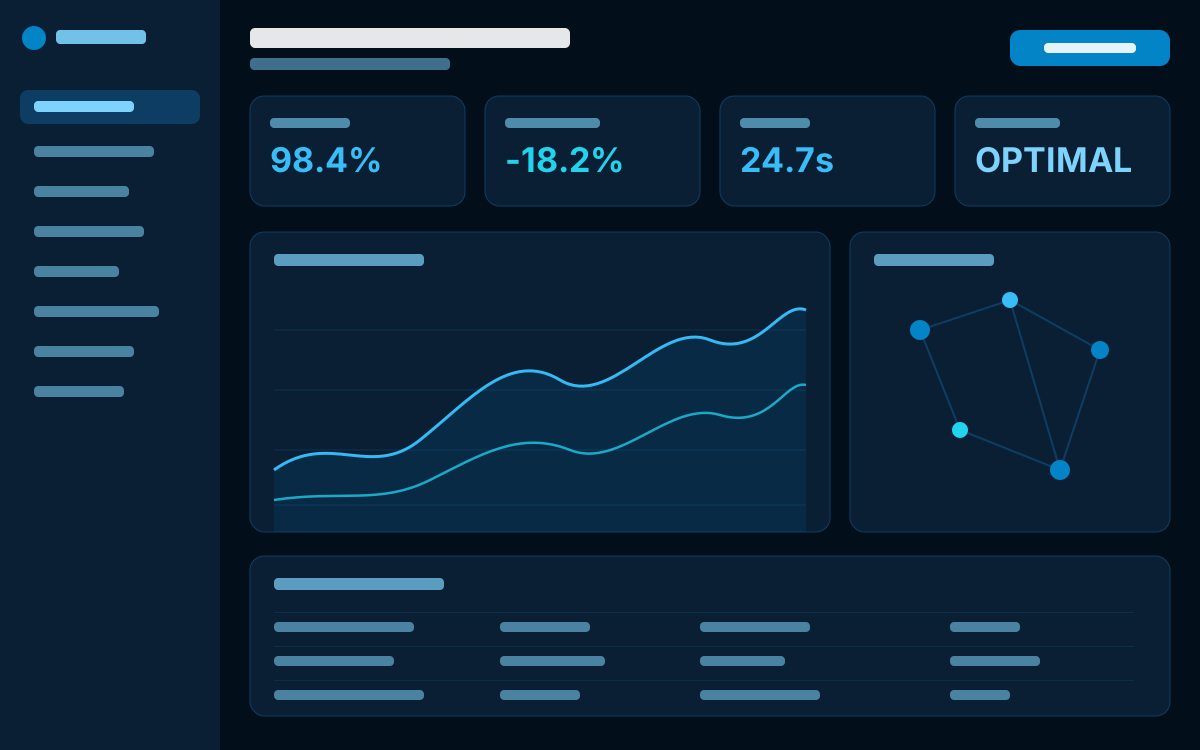
Domain-aware KPI dashboard across 13 built-in sectors
Live network map with Leaflet tiles and node-level drill-down
Client sign-in is by registration — see Atlas Core above for a demo you can try right now, no account required.
app.forbaysolutions.com
How Atlas works
From system signal to operator action.
A transparent optimisation workflow that strengthens operator judgment instead of hiding it behind a black box.
01
Integrate
Connect your live data, constraints, and objectives—from any source. SCADA, REST API, historian, or manual input.
02
Optimise
Atlas solves your scheduling problem in under a second. No black box. You see the trade-offs and why each decision was made.
03
Decide
Your operators get a recommendation, the evidence, and the trade-off. They stay in control. Atlas is advisory, never automatic.
Engineered for reality
One decision engine. Every infrastructure type.
Forbay built Atlas to close the gap between optimization research and the daily realities of operating water, energy, manufacturing, and building infrastructure. Every recommendation respects real equipment constraints, service obligations, and your team's judgment.
Explainable decisions—you see why, not just what
Integrates with your existing systems and data
Safe: always advisory, never automatic control
4Infrastructure domains (shipping 12 more)
500+Automated test cases
<1sTypical solve time
FA
F. Awol, P.Eng., Ph.D.
Founder & Principal Engineer
Hydraulic modelling, mathematical optimisation, and real-time control systems across water, energy, and industrial infrastructure. The same optimisation core that schedules a pump station also schedules a job shop or a gas compressor.
Your system, clearer
Bring us the constraint that keeps you up.
We'll map an Atlas walkthrough to your infrastructure, models, and operating challenge — no generic demo, no sales deck.